
“Adopt the peace of nature. Her secret is patience” – Ralph Waldo Emerson
Compliance Management
Marine Living Resources Act
During June, the Rangers came across a total of 52 fishermen; recreational fishing, spearfishing/diving, and bait collecting permits were inspected by Stefan, MC and Divan in accordance with the Marine Living Resources Act (Act 18 of 1998). Of the 52 permits checked, seven failed to produce a valid permit. We remind everyone that it is essential to be in possession of a permit, even if you are simply fishing for a day or two! We ask that if you witness any fishermen, divers, or bait collectors and suspect they are not following the rules and regulations, please get in touch with the Conservancy immediately.
A joint patrol between Fransmanshoek Conservancy and the Department of Fisheries (DFFE) was conducted on the 16th of June, 2026. The operation stretched from Springerbaai Coastal Eco-Estate to Gourtismond.
The result:
– Three (3) fines were issued to the value of R3,500.
– Ten (10) permits were inspected.
– One (1) individual was found in possession of 128 live alikreukels, which were still alive and
placed back into the water.
Natural Resource Management
Die Voortrekkers
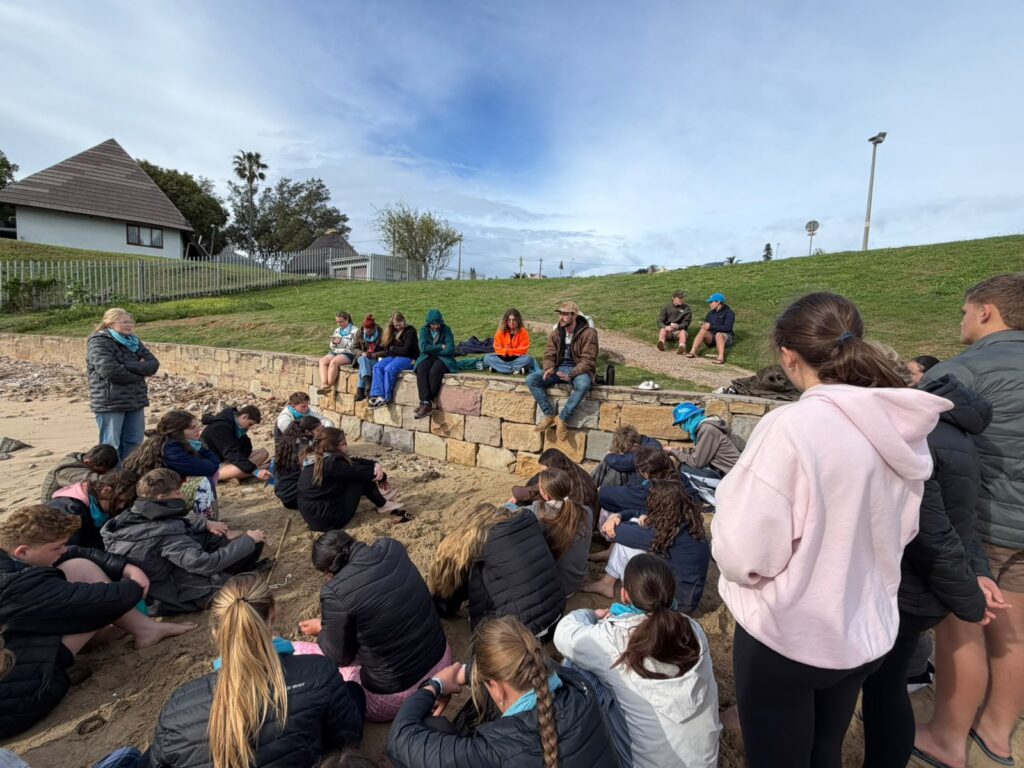
Over the course of several days, we had the enriching opportunity to engage with two distinct groups of Voortrekkers as part of our ongoing environmental education and outreach initiatives. These interactions provided valuable platforms to foster a deeper appreciation for nature, heritage, and sustainable living among the youth. On June 30th, our Rangers welcomed the first group of Voortrekkers, consisting of eager and curious young individuals exploring traditional survival and subsistence methods inspired by our forefathers. The educational focus for the day centered on mussels and the vital role they play in the ecosystem. The Rangers demonstrated the ethical and responsible collection of mussels, followed by proper cleaning techniques. This culminated in the group preparing and consuming the mussels as part of their dinner, an activity that combined cultural heritage with ecological mindfulness.
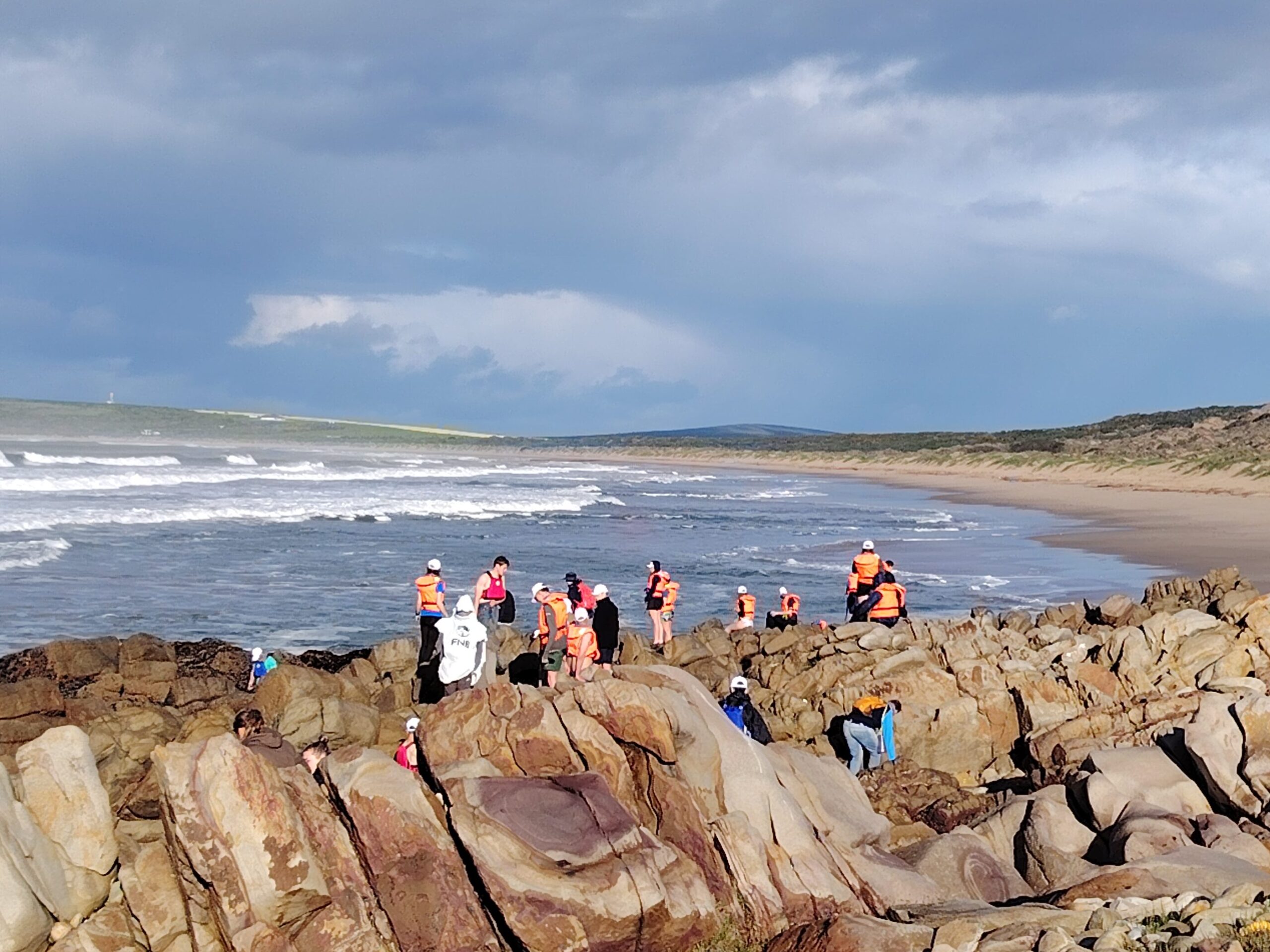
On July the 3rd, our team travelled to the Mossel Bay area to meet a second group of Voortrekkers. This session focused on deepening participants’ understanding of local fauna, flora and the general workings of an ecosystem. A special emphasis was placed on the Rooikrans/Red-eyed Wattle (Acacia cyclops), an invasive species increasingly threatening indigenous biodiversity. The group discussed the ecological consequences of introducing non-indigenous plants and the importance of invasive species control in conservation management. The Rangers also facilitated an interactive Q&A session, where participants inquired about career paths in conservation, qualifications needed, and daily responsibilities involved in environmental work. This proved highly engaging and inspired several of the youth to consider future involvement in ecological fields.
Donation
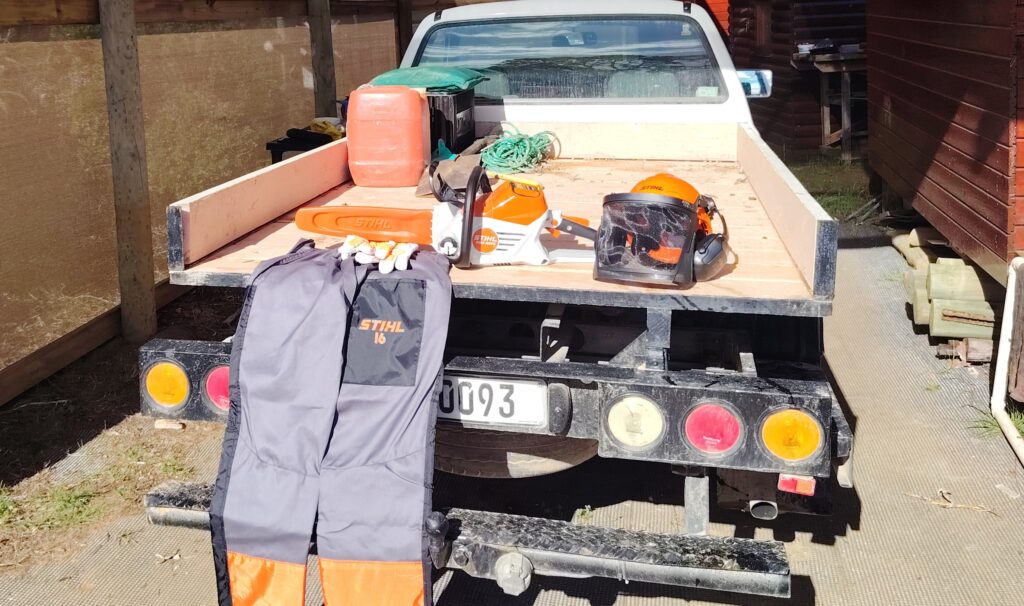
A heartfelt thank you to our generous donors, The Mossel Bay Conservancy Forum NPC and The Garden Route Casino Community Trust for the invaluable donation of a chainsaw and personal protective equipment (PPE) to the Fransmanshoek Conservancy. This generous contribution will make a significant difference to our conservation efforts by helping our rangers work more safely and efficiently while maintaining trails, clearing invasive vegetation, and responding to environmental management needs. Your support strengthens our ability to protect the natural heritage of the Fransmanshoek Conservancy, and we are truly grateful. Our rangers will put this equipment to excellent use in caring for the conservancy for the benefit of both nature and the community.
Environmental Education
Tidal Pools
Along the Cape coast tidal pools are common occurrences that are created by the receding tides that reveal a fascinating world between the land and sea. These pools of trapped seawater create a miniature ecosystem that create unique habitats which host a diversity of marine life.
Each tidal pool is unique. Some are shallow and warm rapidly under the summer sun, while others are deep enough to remain relatively cool throughout the day. Their size, depth, position on the shore, and exposure to waves all influence the communities of organisms they support.
Unlike the open ocean, where temperatures remain relatively stable, shallow tidal pools can heat rapidly under direct sunlight and cool quickly during winter or at night. Some pools may experience temperature changes of more than 10°C within a single day. These fluctuations place considerable stress on marine organisms. Many species have evolved physiological adaptations that allow them to tolerate a wide range of temperatures, while others seek shelter beneath rocks, within crevices, or beneath seaweed to avoid extreme conditions.
Additionally, the salinity of these pools may also fluctuate through factors such as rain which may dilute the water and evaporation from the sun which may cause the water to become saltier. Oxygen levels may also fluctuate in these pools through factors such as high tide which may replenish the oxygen in the water while the respiratory actions of the organisms, such as algae, may cause oxygen levels to decrease. Many of the organisms that are found in these pools are remarkably well adapted to these fluctuations.
Despite these harsh conditions, tidal pools support an astonishing diversity of organisms.
Seaweeds and algaes usually form the foundation of tidal pool ecosystems as they can produce food for themselves through photosynthesis while also providing food and habitat for other organisms.
Some of the animals that rely on seaweed, algae and kelp as a source of food are the mollusks such as snails, limpets, mussels and even abalones. Some limpets and species of grazing snails feed on microscopic algae growing on the surfaces of rocks which they tend to scrape off. Many of the mollusks, especially the more sessile species, that can be found in tidal pools feed through filter feeding. This includes mussels which can form dense beds where each individual filters through the water, especially moving water, for food particles and plankton. These beds also create a habitat for even smaller species. Abalone feed using a specialized rasping tongue called a radula to scrape and tear plant matter. Their diet changes drastically as they grow with juveniles grazing on benthic diatoms, microalgae, and bacterial films and adults feeding on large seaweeds, preferring floating scraps of kelp and red or green algae.
Colourful sea anemones are also commonly found in these pools and are usually seen with their tentacles protruding. These delicate tentacles are used to pull food towards their mouth parts. Believe it or not but these organisms are actually animals that are related to jellyfish, hydras and corals, which are also classified as animals.
Many crustaceans may also be found in tidal pools and are usually seen moving or hiding among the rocks or seaweed. These usually include crabs, prawns and lobsters. In some cases these animals are not restricted to the pool itself like many of the other organisms and they can move between different pools or between the pools and the ocean, this can especially be seen in crabs. Crustances are usually found in these pools looking for food or seen taking shelter.
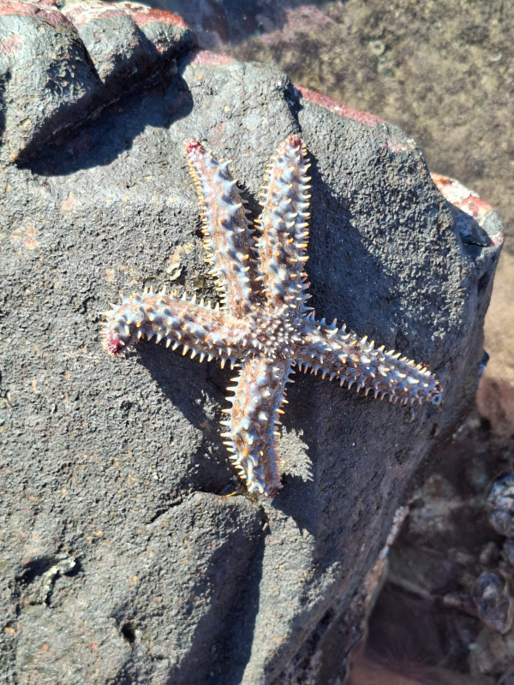
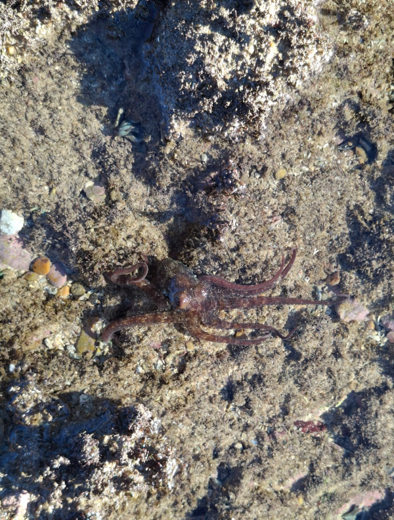
Other unique species or animals that may inhabit tidal pools include sponges, sea stars, brittle stars, sea urchins as well as sea worms, such as the plant like fan worms, and the sometimes brightly coloured sea slugs. Another very unique animal that can be found in tidal pools are octopuses. These animals are well known for their excellent ability to camouflage among their surroundings and squeezing themselves into the smallest of spaces which can make them a rarer but welcome sight in the pools. They are also known for being fast swimmers, their beak-like mouth structure and their ability to shoot ink as a defence mechanism. Additionally, they have also shown to be rather intelligent making use of their highly mobile tentacles to solve problems and even manipulate their surroundings. One such example is when they cover themselves with shells in order to hide or provide protection for themselves.
One of the most important roles tidal pools can play is to act as nurseries for many species of young fish. These rock nurseries provide a safe location, free of predators, where young fish can feed, grow and develop safely before eventually returning to the ocean. Seaweeds further increase habitat complexity by creating shelter among their fronds, reducing predation and providing abundant food for developing organisms. Some of the species where the young can be found in tidal pools include galjoen, blacktail, white musselcracker and white steenbras.
Not all fish species found in the tidal pools make use of them as nurseries, some do live there almost permanently. This includes probably one of the most commonly seen fish in these pools, the Klipvis. There are 39 different species of Klipvis found exclusively in Southern Africa and they primarily feed on invertebrates. The reproduction of these fish can be rather unique compared to other fish as the mating process can take up to an hour or even longer and they do not lay eggs with the females giving birth to live fully developed young.
The ecology of tidal pools generally has various seaweeds and algae acting as the primary producers and the basis of the food chains in the food webs of the ecosystems similar to plants in terrestrial ecosystems. These producers are in turn fed on by herbivores which usually consist of animals like snails and limpets which prevents the producers from dominating rock surfaces. These herbivores are then sometimes, if they are present in the pool, preyed upon by predators which may include animals such as sea stars, crabs and octopus which helps to regulate the population of the herbivores which prevents the herbivores from over feeding on the seaweed and algae which is required for providing food and the oxygenation of the water in the pool. If the number of herbivores are not controlled it could lead to a total population collapse of the herbivores due to them removing the food sources, through over utilization or overgrazing, which at some point could no longer sustain the herbivore population sustainably. In many cases the predators that prey on these herbivores may become prey to even larger predators or themselves and could include animals such as fish and even those from outside the pool such as birds.
Furthermore, competition for space is one of the defining features of rocky shore ecology. Because hard surfaces are limited, organisms compete intensely for attachment sites. Mussels, barnacles, seaweeds, and encrusting algae constantly expand into available space, while storms and grazing animals periodically create opportunities for new species to establish themselves.
However it should also be noted that despite tidal pools being areas of ecological and biodiversity importance it still faces some threats. This includes climate change, pollution, coastal development and the collection of marine life. Some of the work that is being done in order to mitigate these effects include beach cleanups, sustainable harvesting as well as general awareness. Some of the most effective conservation methods are usually when these tidal areas fall under an area that is declared a protected area. In many cases this includes nature reserves, coastal reserves or marine protected areas. Examples of these include Table Mountain National Park and De Hoop Nature Reserve.
Another way in order to help conserve the habitats of tidal pools is through exploring them responsibly. While exploring tidal pools can be an exciting opportunity to witness the local marine life it is also important to note that some actions may be harmful to these habitats but it can be mitigated or prevented through simple actions such looking carefully before stepping to avoid crushing small organisms, if you lift a rock return it to its original position, leave animals where you find them, avoid using buckets to keep marine animals for extended periods as they may die of stress or lack of oxygen in the water, do not remove limpets, mussels or anemones from rocks, take photographs rather than souvenirs and dispose of litter responsibly. While the removal of animals such as limpets and mussels is legal it should only be done with the proper permit and within the allocated bag limit.
Finally, these miniature marine ecosystems remind us that biodiversity is not confined to distant coral reefs or remote wilderness areas. It exists along our own shores, waiting to be discovered. Protecting tidal pools means protecting an entire community of life that depends upon the narrow strip where land meets sea not only for the remarkable organisms that call them home, but also for the people who find inspiration, education, and wonder within their waters.
Monthly Species Profile – Black Mussels
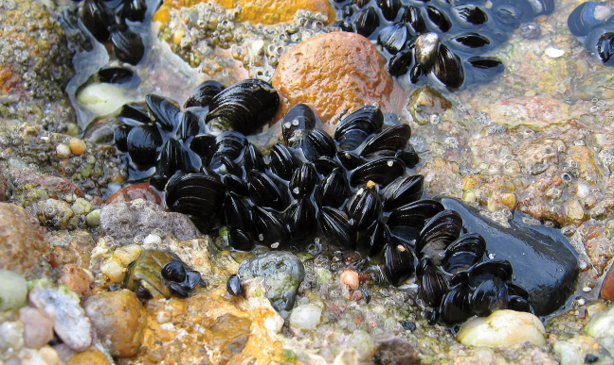
Scientific name: Choromytilus meriodionalis
Family: Mytilidae
Description: Choromytilus meridionalis is a large marine bivalve mollusc commonly known as the South African Black Mussel. It is native to the rocky shores of Southern Africa, where it forms dense beds in the intertidal zone. This filter-feeding species removes plankton and organic particles from seawater, helping to improve water quality while also providing food and habitat for many other marine organisms. Its dark blue to black shell and ability to withstand strong waves make it well adapted to the harsh conditions of the South African coastline.
Distribution: Choromytilus meridionalis is endemic to the Southern African coast and occurs from central Namibia, around Lüderitz, south along the west coast of South Africa, around the Cape Peninsula, and eastwards to Port Elizabeth in the Eastern Cape. It is most abundant on exposed rocky shorelines in the lower intertidal and shallow subtidal zones, where it forms dense mussel beds by attaching firmly to rocks with strong byssal threads. The species thrives in cool, nutrient-rich waters influenced by the Benguela Current on the west coast and extends into the warmer waters of the south coast where suitable rocky habitat is available. These extensive mussel beds provide food, shelter, and attachment surfaces for numerous marine organisms, making the species an important ecological engineer in Southern African coastal ecosystems.
Diet: Choromytilus meridionalis are filter feeders, feeding on micro food particles that they filter out of the water. These food particles make it to the mussels through tidal and wave movement. Some of these particles include floating microalgae, such as phytoplankton, decaying kelp as well as suspended particulate organic matter. Additionally, they also ingest bacteria which serves as an essential nitrogen source that helps with growth.
Life cycle: The South African black mussel reproduces through external fertilisation, where males and females release sperm and eggs into the water column during spawning events. Fertilisation occurs in the surrounding seawater. The species has separate sexes and, in many parts of its range, undergoes two main spawning seasons each year, although gamete production occurs throughout the year.
After fertilisation, the embryo develops into a free-swimming trochophore larva, which soon transforms into a veliger larva. The veliger feeds on microscopic plankton while drifting in the water column. After approximately two weeks, the larva develops into a pediveliger, producing a small foot that allows it to search for a suitable surface for settlement. It then attaches to hard substrates such as rocks, ropes, or buoys using byssal threads and undergoes metamorphosis into a juvenile mussel (spat). Juveniles grow into adults over several months and eventually become sexually mature, completing the life cycle.
Conservation Status: Choromytilus meridionalis has not been evaluated by the International Union for Conservation of Nature and therefore does not have an official IUCN Red List conservation category.
Reference
WoRMS Editorial Board. (2026). Choromytilus meridionalis (Krauss, 1848). World Register of Marine Species. https://www.marinespecies.org/aphia.php?p=taxdetails&id=224609
du Plessis, A. J. (1977). Larval development, settlement and growth of the black mussel Choromytilus meridionalis in the Saldanha Bay region. Transactions of the Royal Society of South Africa, 42(4), 303–316.
Griffiths, R. J. (1977). Reproductive cycles in littoral populations of Choromytilus meridionalis and Aulacomya ater with a quantitative assessment of gamete production in the former. Journal of Experimental Marine Biology and Ecology, 30(1), 53–71.
Malherbe, H. & Samways, M., 2014, ‘Rocky shores of a major southern African Marine Protected Area are almost free from intertidal invertebrate alien species’, Koedoe 56(1), Art. #1206, 5 pages. http://dx.doi.org/ 10.4102/koedoe.v56i1.1206
Puada, C. A. (2014) The roles of intertidal marine gastropod shell as secondary substrate for macroalgae. University of the Western Cape. https://uwcscholar.uwc.ac.za/items/8a042d05-3d77-4d0e-9dd3-0b84670ab341
Stefan Otto
MC Prins
Divan Breet
FRANSMANSHOEK CONSERVANCY
082 084 2791 | fransmanshoek@gmail.com
Like and Follow us on: @fmhconservancy