

“Natue does not hurry, yet everything is accomplished ” – Lao Tzu
Compliance Management
Marine Living Resources Act
During November, the Rangers came across a total of 20 fishermen, recreational fishing, spearfishing/diving, and bait collecting permits were inspected by Ethan and Erich in accordance with the Marine Living Resources Act (Act 18 of 1998). Of the 20 permits checked, none (0%) failed to produce a valid permit. We remind everyone that it is essential to be in possession of a permit, even if you are simply fishing for a day or two! We ask that if you witness any fishermen, divers, or bait collectors and suspect they are not following the rules and regulations, please get in touch with the Conservancy immediately. February 2026
Natural Resource Management
Marine and Coastal Birds
On the 20th of February this year the rangers in collaboration with CapeNature conducted a coastal CWAC (Coordinated Waterbird Count) count in order to assess the coastal bird species residing in the conservancy. There were around 10 species of coastal birds, such as terns and gulls, and 3 species of water bird, such as herons and geese with an estimate of around more than 300 individual birds spotted. Nesting sites were also spotted for species such as African Black Oystercatchers (Haematopus moquini).
This is good news for conservation in the conservancy as it shows that these bird species are not only visiting the conservancy but also nesting here. This highlights the importance of conserving our coastal sections. It should be noted that some of these bird species nest in the dunes or sandy areas of the beach, such as oystercatchers and plovers, and not just among the rocks. This a reminder for visitors and residents in the conservancy to please be on the lookout for these sandy nests when using the beaches especially when taking a seat as the presence of people near the nest can deter the parents from sitting on their eggs which can prove fatal for the eggs even if just exposed to the sun for a few hours.
While we do not always utilize our marine and coastal bird species directly we do frequently share resources and spaces such as many fish species and beach areas which both humans and birds make use of. Pelargic fish are one of the biggest resources humans and birds have to share as humans consume large quantities of these fish and species of birds rely on them as a main food source.
One of biggest examples of this are African Penguins (Spheniscus demersus) which rely heavily on pelargic fish, such as sardines, which have negatively affected them due to competition with human fisheries which have heavily targeted sardines which has led to overfishing.
This creates a responsibility for us as humans to properly utilise our resources as negligence can not negatively affect the future generation of our own species but also of those of other species and may even lead to their extinction. That is why the sustainable use of living and non-living resources is important as they help to support us and also entire ecosystems which almost every organism, including humans, rely on.
Environmental Education
Keeping our beaches clean
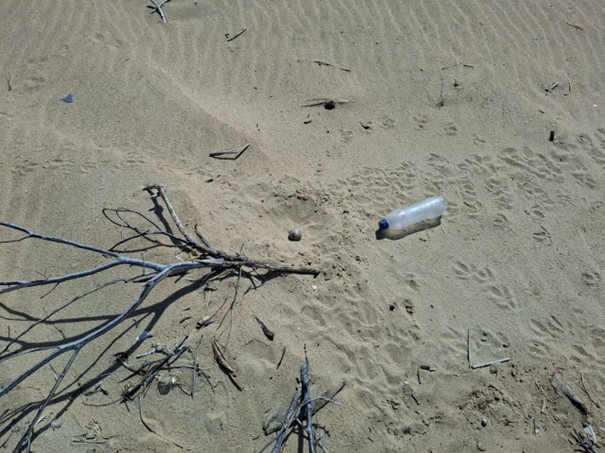
Keeping our beaches clean is of utmost importance. Not only for us but also the animals that use these beaches to rest, breed and feed. Animals don’t know the difference between food and plastic. This is a problem for the animals that use these beaches and we created the problem. It is critically important to keep our beaches clean as the animals that use them play a very important role in the ecosystem. If we keep our beaches clean it is a lot saver for our marine animals as well as for us humans. Walking and fishing on a clean beach is a lot more enjoyable than if it is dirty.
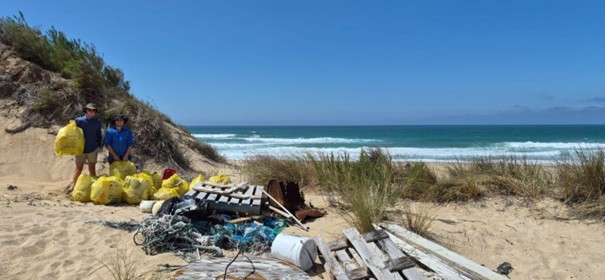
The rangers and two volunteers came together and cleaned a section of the beach. After big rain storms and strong winds a lot of waste washes up on the beach and it needs to be cleaned. In approximately 3 hours we picked up 12 full plastic bags of waste. This ranges from plastic bottles to wood pallets and even shoes. These things are dangerous to our marine animals as small fish can get stuck in bottles for example. We also found larger things like wood pallets, paint cans and fuel cans.
Monthly Species Profile
White-Fronted Plover
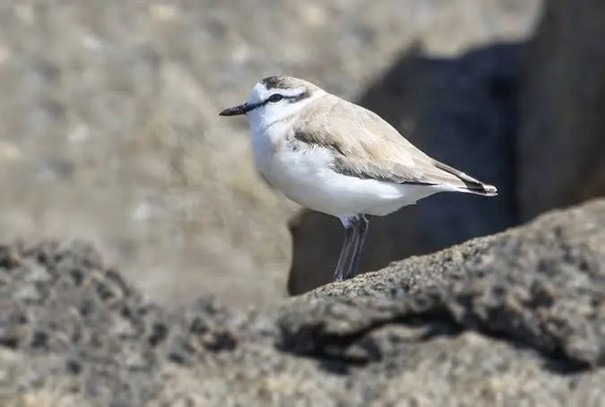
Scientific name: Anarhynchus marginatus
Family: Charadriidae
Description: The White-Fronted Plover is a small coastal shorebird found along sandy beaches and estuaries in southern and eastern Africa. It has pale brown upperparts, white underparts, and a distinctive white breast, with a dark patch on the shoulder and a thin dark bill. This bird typically runs quickly along the shoreline, feeding on small crustaceans, insects, and marine invertebrates in the sand. It nests directly on open sandy beaches, where its eggs are well camouflaged.
Distribution: The White-Fronted Plover is mostly found on the shores of eastern and souther southern Africa. Its range extends from Namibia and Angola to South Africa o on the west coast and Mozambique, Tanzania, Kenya, and Somalia on the east coast.
Habitat: The majority of the White-Fronted Plover’s habitat is coastal. It favors areas with open sand and minimal vegetation, such as estuaries, coastal dunes, and sandy ocean beaches.
Diet: Small invertebrates found near sandy beaches are the White-Fronted Plover’s primary food source. It eats insects, mollusks, marine worms, and tiny crustaceans. It forages by sprinting along the shore and grabbing prey from the sand, frequently in the intertidal zone’s moist sand or shallow water.
Reproduction: The White-Fronted Plover typically breeds above the high-tide line on open sandy beaches. By scratching a shallow hole on the sand and occasionally lining it with tiny shells or pebbles, it creates a basic nest. Usually, the female l lays two to three well-camouflaged eggs which blend in with sandy areas. The eggs are incubated by both parents alternately, and they hatch after 25 to 28 days. The chicks are precocial, which means that they leave the nest soon after hatching and are capable of moving around and feeding themselves while being guided and protected by their parents along the beach.
Conservation Status: The White-fronted plover status is currently least concerning due to their large range and population size. Their population is decreasing as beaches get more populated and loss of habitat.
References
BirdLife South Africa, White-fronted Plover. [Online] https://www.birdlife.org.za/red-list/white-fronted-plover [Accessed March 2025]
Two Oceans Aquarium, African Penguin. [Online] https://www.aquarium.co.za/animals/african-penguin [Accessed March 2025]
Divan Breet
MC Prins
Stefan Otto
FRANSMANSHOEK CONSERVANCY
082 084 2791 | fransmanshoek@gmail.com